Artificial Intelligence and its Application
Efficient Machine Learning
Machine Learning Accelerators
Deep Learning
Machine Learning Compilers
Probabilistic Machine Learning
Machine Learning for Geospatial Modelling

One degree programme, many opportunities
Simulation of tsunami waves triggered by the Tohoku earthquake on March 11, 2011.
Image: Alexander Breuer
In recent decades, computer-aided prediction of phenomena in science, industry and society has become a key technology of the modern information society. Today, no medicine, aeroplane or solar system is designed without first being sufficiently simulated on a computer. With the ongoing digitalisation of society (social networks or digital footprints), the increasing use of high-resolution sensor technology (in the environment or automotive industry) or computer simulations, large amounts of data are also being generated. Far-reaching advances in science, industry and society will therefore rely even more on the ability to analyse large amounts of data and simulate phenomena with the help of computers. The aim of the interdisciplinary degree programme is to teach students these fundamental skills in combination with an application discipline such as Neuroscience, Biology or Geology, thus preparing them for the challenges of the professional world of the coming decades.
Special features in Jena: Simulations with a high degree of realism and the analysis of large amounts of data can only be achieved using modern algorithms and their efficient implementation on powerful computers. Therefore, teaching the use of high-performance computers, in which several processors work together to solve the same problem, is an integral part of this degree programme.
The curriculum of the CDS degree programme is divided into a compulsory area and a compulsory elective area.
The compulsory area is designed to prepare students for the various challenges posed by interdisciplinary issues. This subject area|field is intended to ensure that graduates have the necessary foundations to develop innovative solutions to complex problems that may arise in the various fields of application.
The compulsory area consists of compulsory courses in the following three different subject areas:

3D visualisation of an earthquake simulation.
Image: Alexander Breuer
Picture of the Ara server at FSU Jena
Image: Andre Sternbeck (Universität Jena)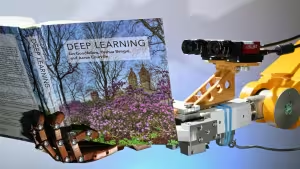
A robot holds a book in its artificial hand. It appears to be reading a non-fiction book with its eyes.
Image: Jan-Peter Kasper (University of Jena)The compulsory elective area is used to specialise within a study profile, which students choose individually. The following list shows possible study profiles in alphabetical order. Students can design further study profiles in consultation with the person responsible for the degree programme and the relevant subject areas.


